
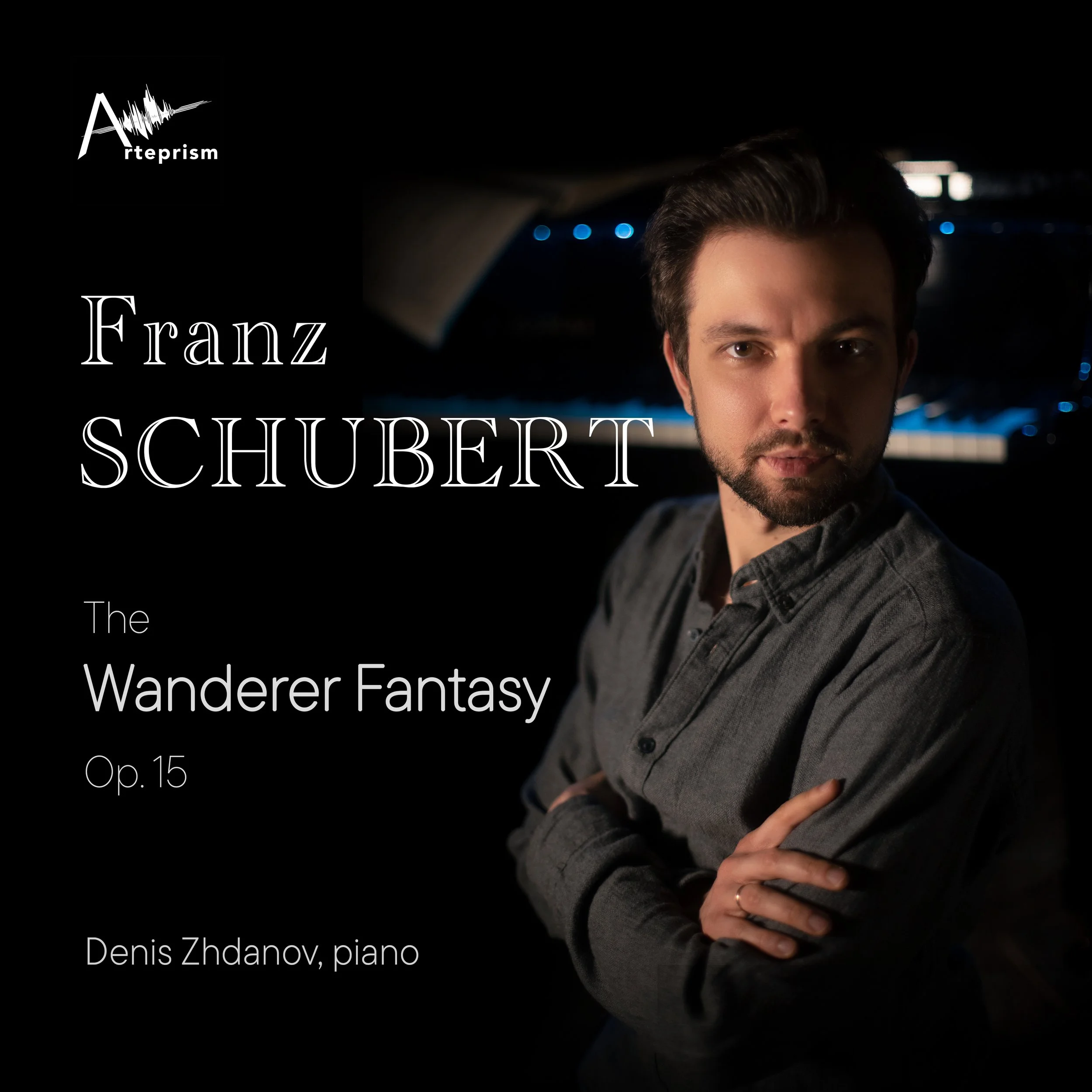
Single: Franz Schubert Wanderer Fantasy op. 15
COMING SOON
Release Date: April 17, 2026
Artists: Denis Zhdanov
Franz Schubert’s Wanderer Fantasy (D.760) is one of the most powerful and original works in the piano repertoire. Written in 1822, it is built around a theme from his song Der Wanderer, whose words say: “I am a stranger everywhere.” This melody appears most clearly in the second movement, but in fact it shapes the entire piece. All four movements are connected and grow out of this single idea, forming one continuous journey.
The first movement is full of restless energy — urgent, dramatic, always moving forward. It feels like a search, with no place to settle. The second movement turns inward — calm, introspective, almost frozen in time. Here we hear the voice of the Wanderer himself: distant, lonely, and detached. The third movement brings brilliance and motion — almost playful on the surface, but still unstable underneath. And in the final movement, everything is transformed into a powerful fugue — intense, driven, and uncompromising, as if the music is pushing toward a final truth.
This piece is also one of the most technically demanding works Schubert ever wrote. He himself is said to have remarked — after attempting to play the piece for his friends and breaking down in the third movement because of its extreme difficulty — something along the lines of: “let the devil play it.” The pianist faces continuous challenges — fast octaves, dense chords, and relentless momentum — but beyond that, the real difficulty is to shape the entire work as one long arc, holding together its emotional and structural unity.
I have always felt that works like this are very natural for me. I learned the piece quickly when I was about twenty, and by nature I have always been a more “elemental” pianist — drawn to wild, virtuosic, passionate, and direct music from a young age. Interestingly, the movement that gave me the most difficulty back then was the slow one. I felt its depth, but I wasn’t sure I had fully discovered it within myself to express it honestly.
Returning to this work later for this recording was especially meaningful. It became one of the first truly demanding pieces I recorded after recovering from serious hand issues that had stopped me from performing for almost a year. That period forced me to rethink my technique completely and develop a much more efficient, sustainable approach to playing. At the same time, life experience brought a new perspective — after various struggles and inner changes, I finally felt more ready to meet the depth of the second movement. In that sense, this recording is not just a return to a piece, but a reflection of a personal journey.